

Recently, chat records claiming that a major internet company used AI to replace some positions, resulting in large-scale layoffs, went viral online. Although such chat records should not be readily believed, we strongly recommend that you learn relevant knowledge about layoffs in advance.
- What is “Layoff”
In daily language, the term “layoff” under China’s Labor Contract Law generally refers to two scenarios:
- Economic layoffs
Economic layoffs are measures adopted by an employer to improve its operation by reducing headcount when the employer suffers from poor business performance. Three conditions must generally be met:
(1) The employer is in poor business condition (e.g., bankruptcy reorganization, serious difficulties in production and operation, etc.);
(2) The number of employees to be laid off is 20 or more, or accounts for 10% or more of the total number of employees;
(3) Statutory procedures are fulfilled (including explaining the situation to the trade union or all employees, and filing with the labor administrative department).
- Termination of labor contract in advance by the employer on the ground of material change of objective circumstances
This refers to the circumstance where an employer may unilaterally terminate a labor contract pursuant to Article 40(3) of the Labor Contract Law, when a material change of the objective circumstances upon which the labor contract was concluded renders performance of the contract impossible.
Two conditions must generally be met:
(1) A material change has occurred to the objective circumstances on which the labor contract was concluded, rendering the contract unable to be performed;
(2) The employer and the employee fail to reach an agreement on amending the labor contract (common examples include post adjustment, change of work location, etc.).
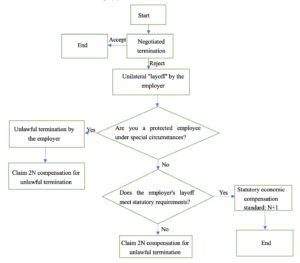
Under the above two scenarios, the statutory standard for economic compensation for unilateral termination of the labor contract by the employer is N+1.
However, if an employee falls within any of the six circumstances prescribed in Article 42 of the Labor Contract Law(e.g., suffering from a work-related injury or occupational disease and having lost or partially lost the capacity to work, being within the medical treatment period, or a female employee during her pregnancy, maternity leave or lactation period), the employer shall not unilaterally terminate the labor contract on the grounds of the above two situations.
- Why Do Companies Opt for Negotiation?
The above two scenarios are in essence the legal grounds for an employer to unilaterally terminate a labor contract. However, from the perspective of risk control and efficiency, employers will negotiate with employees on the termination of labor contracts either during or prior to going through the statutory procedures for layoffs.
During the negotiation, the employer will propose an economic compensation plan, which may be N+1 or a more favorable scheme. Both parties may employ excellent negotiation skills to reach a termination plan satisfactory to both sides.
III. What Are the Consequences of Negotiation?
If the parties reach a termination agreement, the employer is not required to proceed with the procedures for economic layoffs or unilateral termination based on material changes of objective circumstances. Instead, the provisions of Article 36 of the Labor Contract Law regarding termination by mutual consensus shall apply directly, and such termination is not subject to the restrictions on protected employees.
It should be noted that once an employee signs a mutual termination agreement with the employer, the possibility of subsequently revoking the agreement or claiming it invalid is extremely low.
If negotiations between the employer and the employee fail at this stage, the employer will proceed with the statutory procedures for economic layoffs or unilateral termination due to material changes of objective circumstances.
If the employer’s unilateral termination is found to be illegal—for example, failing to meet the statutory conditions for economic layoffs or not completing statutory procedures—the employee may claim 2N compensation (statutory double compensation for illegal termination).
What are you jabbering about? Too much text to understand? Check the flowchart below to see which category you fall into!
Ⅳ. Conclusion
For enterprises, “layoffs” should not only be pursued quickly and harshly, but also follow basic principles. Otherwise, they may end up paying twice the cost. For employees, they should hold firm to their bottom line of acceptable compensation and strive to safeguard their rights and interests to the greatest extent within the scope of the law. Both employers and employees may consult professionals when necessary.
Originally published by PW & Partners Law Firm